|
The Psychedelic Vision at the Turn of the Millennium:
Discussion with Andrew Weil, M.D.
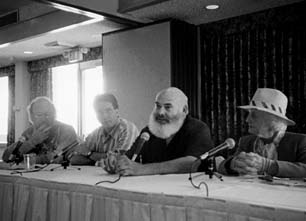
The following is exerpted from the pre-conference of the 1997 Association
for Transpersonal Psychology Conference held at Asilomar Conference Center
- Monterey, California; August 1-3, 1997.
The pre-conference was entitled
"The Psychedelic Vision at the Turn of the Millennium." The featured
speakers were Charles Grob, M.D., Laura Huxley, Dennis McKenna, Ph.D.,
Terence McKenna, Ralph Metzner, PH.D. and Andrew Weil, M.D.
(pictured here from the left: Dennis McKenna, Charles Grob, Andrew Weil, Laura Huxley)
C. Grob: It is my pleasure to welcome you to the morning session of The
Psychedelic Vision at the Turn of the Millennium.
I would like to introduce our first peaker of the morning, Dr. Andrew
Weil, well known to many of you. He has become an extremely successful and
well-known speaker on the topic of alternative medicine. He has had a
number of books recently achieve best-selling status, including
Spontaneous Healing and Eight Weeks to Optimum Health. His message that
modern medicine needs to avail itself of resources previously ignored,
including the medicines from the plant kingdom and alternative models to
understanding healing and prevention, have now achieved far greater
visibility and respect not only within the population in general but
within the mainstream profession itself.
Andy has recently developed a new and innovative program at the University
of Arizona School of Medicine; a training program, training physicians in
alternative medicine, theory and practice. The center there is called the
Program for Integrative Medicine and it is really a pioneering program in
the training of physicians in alternative models for healing. Andy is a
clinical professor of Internal Medicine at Arizona. In addition to his
recent activities being very visible in the alternative medicine movement,
Andy also has a rich history, going back some years, looking at the
phenomena of altered states of consciousness and particularly substances
that might induce such altered states. In addition to his very important
early works, The Natural Mind and The Marriage of the Sun and the Moon,
written some twenty-five years ago on these phenomena, Andy also was
present in the early days at Harvard University, where psychedelics first
became an issue in the public domain and in fact, was a reporter then, I
believe an editor for the Harvard Crimson, breaking the story to the
Harvard community and the world.
So, Andy is with us today, having gone through a tremendous odyssey over
the years, and is still quite willing and quite happy to talk about his
early interest, which I believe is still an active interest. I give you
Andy Weil.
A.Weil: Good morning. Laura [Huxley] has offered to sit next to me for
moral support. I will tell her--I told her this once--I will remind you
again of my indebtedness to Aldous for my early experiments. I read The
Doors of Perception in the summer of 1960 and then in that fall I entered
Harvard as a freshman and was very eager to try mescaline as a result of
reading that book. I had no idea, I had never heard of these substances,
I had no experiences of any psychoactive substance other than alcohol, and
in my na•vetˇ, the first thing I did was go to my corner druggist and ask
if he knew where I could get mescaline. He said that he had heard that
there were experiments going on of trying to reproduce schizophrenia in
the laboratory but he had no idea where you could get it. And I remember,
I talked to several people, I asked my family doctor. I made the mistake
of talking about it at the dinner table one night, and I saw the reactions
it produced in my parents so I said nothing further. And then by
coincidence that Fall, Aldous was at MIT as a visiting professor and gave
a series of lectures, I think four lectures on visionary experience, which
were broadcast on the Harvard radio station on Saturday afternoons. I
listened to them entranced, those lectures that later became, I believe,
Heaven and Hell, is that correct?
L. Huxley: No, I think that those lectures are part of a book called, The
Human Situation.
A. Weil: Well, they were very inspiring so I wrote a letter to Aldous
Huxley. I think I sent it to him in care of MIT and he sent a handwritten
letter back, giving me the name of a chemical company that he thought
would sell mescaline. This was called Delta Chemical in New York. I wrote
them a letter, this was in the pre-Thalidomide days when there was not
very much checking about who got what and they would indeed sell
mescaline, but at about five times the price that it should be selling
for, with no questions asked. I then heard that there was a professor
named Leary who was interested in these substances. So I went over to see
him and he said that he was sorry that I couldn't be in their experiments
because he couldn't use undergraduates, but he said I should just keep
checking and I could probably find it. I think I wrote back to Delta
Chemicals and said, did they know anyone else who manufactured mescaline,
and they gave me the names of three companies and they sent out these
forms that were fairly simple to fill out for using the drugs for
investigational use. I mean this was in the innocent days and I found one
of these companies that was willing to sell mescaline and developed a nice
relationship with them. It would arrive by UPS outside my dormitory,
twenty-four hours after I ordered it. So, I am very indebted to Aldous for
the lead. The first time I tried it, I tried it with one other friend of
mine, and there was a group of people in my freshman dorm who were
interested in it, but everybody was quite scared. I and this other fellow
had volunteered to try it first. It was not an ideal setting, with the two
of us taking it with a whole group of people sitting around, waiting to
see what would happen. It was on a Saturday afternoon and my set was so
filled with anxiety that it was about three or four hours before I felt
anything at all. When I did feel something, at the beginning it felt like
alcohol intoxication; that was really the only model I had for what an
altered state was like. At the moment I started to feel something the
phone rang, and it was my mother calling from Philadelphia, who never
called on Saturdays. I mean it was an awkward conversation. She asked me
about the weather and I said it was nice and she said, "Why aren't you
outside," and, "What are you doing?" and I said I was just sitting around
with some friends. She said, "I hope you are not doing anything foolish
like taking mescaline." I had mentioned the word once about two months
before. Mothers...
I SAID THAT I would talk to you about practicalities and my interest is,
"Okay, you have seen the psychedelic vision and you know, now--what do you
do with it?" You can see it over and over if you like, but it seems to me
the challenge is how do you trans-late it and what do you do with it.
There are a lot of people in our culture who have had this vision now, and
our concern is how is this going to be implemented. What can we do about
it.
So again, I will talk very personally about this. Let me begin by just
giving you some of the key elements of the particular vision that I
experienced as a result of psychedelic experimentation. The first, I
think, is a sense of wonder, of just wonder and awe at the universe, at
life, at consciousness. While that may seem simple, one of the things that
has been very disappointing to me and striking in my career in medicine
and the sciences, is the absence of that feeling on the part of many, if
not most of my colleagues and I find that very dismaying. In fact, I even
detect a strong feeling among some of the hard core scientists that I went
up against, that it is the business of science to do away with wonder.
That science is seen as being able to roll back the mystery. I remember
hearing Terence once say, he used an image which is terrific, that the
bigger you build a fire and the more illumination it gives off, the more
it makes you aware of the extent of the darkness beyond. I think that is
very true, that fits with my experience and I think that is very much at
odds with the scientific view, that the business of science is to do away
with mystery. It seems to me that mystery is at the heart of existence and
it is something that one experiences very profoundly as part of the
psychedelic vision, whether it is the heavenly vision or the hellish
vision. That has always been a very motivating force in my life. I think
it has also kept alive my sense of curiosity. I am a very curious person
and I check things out and I do it with this sense of wonder and it seems
to me that is a very healthy attitude to have. Especially very healthy as
a scientist and as a physician. So, I have always tried to inspire that in
people that I come into contact with, and in medical students, but I am
very aware that I am up against a tremendous force in the opposite
direction. It seems to me that is one thing that I try always to counter
in my teaching, that comes directly from that psychedelic vision.
Another aspect of the psychedelic vision, for me, was the sense that
anything is possible. That although there may be relative limits in the
here and now, in some higher sense, there are no limits, that we live in a
universe and that infinity and endless possibility are there. And again, I
emphasize that this is a contrast because I think we live simultaneously
in the three dimensional world where limitation exists and in some higher
dimensional reality where it doesn't, so there is paradox there.
I will give you a very practical story about my experience of no limits. I
wrote it down in a book that Lester Grinspoon edited on the psychedelic
experience, but I will just repeat this for you because it has been for me
a very meaningful model and one that has, again, motivated me in my work.
This incident took place about 1970. I was living in rural Virginia, it
was at the time that I was getting ready to write The Natural Mind and it
was a period of great transition, when I had quit a government job and
dropped out of medicine and was starting to meditate and do yoga and
became a vegetarian. It was a time of great change in my life. Also, the
political times in those days were both scary and very optimistic. One day
in the spring of that year I took LSD with a group of friends, it was a
perfect spring day and I was just in a wonderful state. I had been trying
to start Hatha Yoga, as of a couple of months, and I had a lot of
difficulty with some of the postures. The posture that I had the most
difficulty with was the Plow, where you lie on your back and try to bend
your feet down behind your head and touch the ground. I could get them
down to about a foot from the ground and I would feel an excruciating pain
in my neck. There was no progress at this, I had worked at it for about
two months and I was on the point of giving up. I was twenty-eight, I
decided I was too old and that my body was just out of shape and wasn't
made for this. Well, in this LSD state I was just feeling so happy. I
observed that my body felt completely elastic and springing and I thought,
"Well gee, while I'm this way I ought to try doing the Plow." So I
lay down and I was lowering my feet behind my head and I thought I had about
a foot to go and they touched the ground. I couldn't believe it! And I kept
raising them and lowering them and it was just, it was fabulous. The next
day I tried to do it and I could get my toes to within a foot of the ground
and there was excruciating pain in my neck, but there was a difference now.
The difference was that I had seen that it was possible. And I don't think
I would have believed that, I was on the point of giving up.
That experience of seeing that it was possible, even though it had now
disappeared, motivated me to keep trying, and in the space of about three
weeks I was able to do it. I think if I hadn't had that experience, I
would have given up trying to do it. And to me that is a model for one
aspect of what psychedelics can give you. It can give you a vision of
possibility, but then it doesn't show you anything about maintaining that
possibility. When the vision goes, the drug wears off, you are back where
you were, you haven't learned anything but you have seen that something is
possible. It is then up to you to figure out how to manifest the
possibility. I think that sense of anything is possible has enabled me to
accomplish a lot of things that I have done.
I will tell one story that I relate to that. I am in Arizona by the
weirdest of circumstances, my car broke down there twenty-five years ago.
It was an English Land Rover that I had driven to South America without
incident; I shipped it back. The moment I got it back in this country, it
was a liability. I couldn't get parts for it, I had had it overhauled at
that Land Rover Agency in Laguna Beach and got stuck there for five weeks
waiting for rings, and then I drove to Tucson. I was trying to get to
Oaxaca to deliver a baby of a friend of mine. The Land Rover Agency had
forgotten to pack one of the wheel bearings, which shattered, and it took
six weeks to get a wheel bearing. It was a February. A very warm, wet
winter, the desert was in full bloom; I never left. The baby got delivered
by itself, as they usually do. But anyway, I would have never, in my
wildest imagination, thought I would be living in the desert in Tucson,
Arizona.
ABOUT THREE YEARS AGO my best friend from medical school was named Chief
of Medicine at the University of Arizona by again, total stroke of fate.
He and our dean were a team at the University of Massachusetts, the two of
them had been instrumental in getting Jon Kabat-Zinn's program set up at
the University of Massachusetts. So when he arrived out in Arizona, he
said, "Well now that you have friends in high places, what do you want to
do?" I said, "Well, I would like to change all of medicine." And he said,
"Well, how do you want to do that," and I said, "here is what I would like
to do," and I outlined the basis of this program in Integrative Medicine,
which has now started and is in full swing. Our first doctor trainees are
on board and --this is big stuff--the whole school is behind it. It is, I
think, a model for medical education for the future and it is going to
happen all over the country. And by the way, when people hear about it, I
think the most common piece of feedback I get is people saying, "It's
about time." It is long overdue, you know, and it is about time, but, I
think if I didn't have that sense that anything is possible, I wouldn't
have attempted anything of that sort. But I always do, I just have this
sense of, "Why not?" and I think that comes directly from the
psychedelic vision.
Another aspect of the psychedelic vision for me that has been very
profound, is the sense that everything is alive or that at least, there is
no distinction between what we call living and non-living. That there is
some level on which everything is patterns of energy and that I have
perceived that energy. I remember being in a canyon in Arizona in a
psychedelic state and really being aware and able to see energy
circulating in my hand, which was resting on a rock and to see that the
energy in my hand was the same as the energy in the rock. That this was
the same stuff, that everything is composed of basically the same stuff,
which is in active movement. I think that sense has also led me to be very
open to techniques and ideas in medicine that many of my colleagues find
unable to fit in with their world views.
For instance, I have always been extremely interested in energy healing
and all of the touch techniques. You look at my friend who is Chief of
Medicine, Joe Alpert, a cardiologist; and he is a remarkably open person
to be in the position of Chief of Medicine. As I said, he was a good
friend of Jon Kabat-Zinn's and as a result of his association with our
Program, his horizons have been greatly widened. But he said to me the
other day, "You know you can talk to me about herbal medicine, I have no
problem with osteopathic manipulation or acupuncture, but don't talk to me
about homeopathy." He said, "I don't want to hear it," and this is the
attitude of many. I think of all of the alternatives out there, homeopathy
is probably the one that most pushes the buttons of the scientists,
because it is the one that really challenges the materialistic paradigm.
Here is a system of medicine based on giving people remedies that are so
dilute that there is little chance that the molecules are present and
Hahnemann, who invented this system said that he was liberating the
spiritual essence of the drug in this way. He wasn't interested in a drug
as a material substance, he was interested in it on the non-material
level. Whether you want to call that the energy of the drug or the
vibrational aspect of the drug or the spiritual aspect of the drug, you
can not use that language in talking to medical doctors and scientist. It
just enrages them.
FOR THAT REASON I have deliberately made homeopathy one of the required
subjects that we are teaching in the Program for Integrative Medicine. I
have done that very deliberately because I think it is interesting to see
what happens when you push all those buttons in an academic medical
center. But my reason for doing that is exactly from my direct
experience--from the psychedelic vision--of energy being the basis of
everything, that it is possible to approach the human body on an energetic
level and that may be a very valuable way of doing things. I want to see
what happens there, if you try to look at this in a scientific way or try
or are forced to develop a new conceptual paradigm to explain how
therapies can interact with the human body. I want to push that envelope
and see what happens.
I could go on in this vein but the main thing I want to leave you with is
that for me, the challenge has been to translate these experiences that
I've had in psychedelic states. I don't use psychedelics very frequently
anymore. It is really a period of experimentation that was in my past, but
my work is very actively derived from those experiences. It seems to me
that the challenge in our culture is not to have this vision over and over
again, it is really to see how the vision can be put into practice. How
can you implement it into this sphere of life in which you are involved
and produce change in that sphere, whatever it is. Mine happens to be
medicine and that has been a big one to take on, as you can imagine, but
for a variety of reasons it is very susceptible at the moment to being
moved in a big way. The reasons, by the way, on a material level, are
primarily economic.
Medicine is in enormous economic crisis today, it is really of its own
making. It set out on a course of being very uncritically involved with
technology and the dependence on technology is too expensive. At the same
time it is up against this enormous worldwide, social, psychological shift
among consumers who for a variety of reasons are moving toward natural
things. These combined economic forces are irresistible. Medical
institutions suddenly really have no choice but to move in this direction,
but it is amazing to watch it all happen so fast. At any rate, I am very
optimistic about the possibility for change there. That reminds me of one
other thing. I was interviewed very extensively in the past few months by
a New York Times reporter, who was publishing some long feature, she is a
woman in her mid-thirties who is a Harvard graduate, the daughter of two
Harvard psychiatrists, I liked her very much and she is very thoughtful,
very interesting and she wanted to read my whole body of work and asked
lots of questions. She started asking me about the drug stuff and I said,
"You really should read The Natural Mind first and then come back and talk
to me." So she started The Natural Mind and she called up and said that
she found it such a curious book; she said it seems so dated. I said,
"What do you mean by dated?" and she said, "Well, it just seems like it is
a product of another time." I said that, well, it was, but I said, "What
do you mean by that?" She said, "Well, it is so optimistic." As I began
talking to her about that actually I felt quite sad. She said that in her
peers, her generation, going through college... the sense that you could
change the world, is completely foreign to her, that it is so strange to
read. In a sense, this makes me feel very sad and yet again I think that
that optimism is something that for me derived from the psychedelic
vision. I don't know whether her generation has not had that, but if
younger people find that a dated view of reality, I feel very sorry for
them. I think my sense of optimism is very much confirmed by what I see
actually happening out there.
YOU KNOW, I really do think the world is changeable and that all this can
move quickly and astonishingly. I think also, even though change probably
builds on slow incremental movements, that when it becomes perceptible
sometimes the shifts are sudden. This is a popular view with Chaos
Theorists. To point out an example that I have seen used; if you have a
fish tank with fish and each day you are putting slightly more food in
than the fish can eat, without knowing that one day you come in and the
water is opaque and the fish are dead and floating on the surface. You
wonder how could that be, what happened, but what happened was the result
of very slow increments in which the flora was changed, the oxygen content
of the water was changed. When it reaches a flip point, then there is this
gross obvious change that seems to happen instantaneously. I think that is
the way social change happens and world change happens as well. So, I
think that doesn't spare you from doing the work day to day and putting it
into action but then I think the movements can be very dramatic and sudden
and amazing, so I remain extremely optimistic. And it just makes me very
sad if that is true of the generation younger than me. So, I will stop
there and let you comment.
C. Grob: Thank you, Andy. It's certainly good to have you here at a
meeting like this, talking about these issues. Clearly you are in the
public eye, as a spokesperson for the whole field of alternative medicine,
which is really having an enormous impact on how people are viewing health
and are viewing what they need to do to insure their own health. You are
certainly having an impact being right out there, center stage. What is
also quite extraordinary is looking at your own history and in a sense,
where your early vision was acquired. I think this is one of the
attributes of the psychedelics which often goes unacknowledged; the power
with which they endow individuals with a vision that often takes them
forward in their lives. Even individuals who haven't taken psychedelics in
years or in decades will often trace back pivotal decisions they have made
to those early experiences. I think it is really gratifying to see you,
particularly now in your position of prominence, very willing to speak of
such early experiences.
It is also quite fascinating to examine the medical profession in flux.
One of our institutions that seems to be so impervious to even the
slightest change, is now moving at a rapid rate. I wonder at what point
might our professions start to open up to the potentials that psychedelics
might have in terms of helping us understand health, understand illness
and understand new methods to intervene. Sometimes I, in my wildest of
optimistic visions, imagine a whole field of psychedelic medicine devoted
really to studying this phenomenon, a phenomenon that has gone virtually
ignored by Western medicine. But if you look back on the roots of our
healing structures, that which we inherited from our ancestors, we see
that much of early, very early so-called primitive medicine was on the
Shamanic healing model, which often used altered states acquired through
one method or another to facilitate healing; either through the healer
getting inside into the malady of the person and implementing energetic
changes, or the patient him or herself entering an altered space to
facilitate a process of healing. If we look to the future and anticipate
an evolution of our medical systems, might it be possible even to imagine
a role that psychedelics might play? Even a role that is accepted and
valued?
A. Weil: Actually that reminds me, I left out one very important component
of the psychedelic vision, which for me was the real experience that
external reality can be changed by changing internal reality. That is,
that by doing something in here, everything out there changes and I think
that has enormous relevance for medicine. I will give you another personal
experience. I think this was on a different occasion than that one I told
you about with the yoga experience, but it was again with LSD. I had had a
lifelong allergy to cats and didn't like cats. If I touched a cat and then
touched my face my eyes would itch and swell, and if a cat licked me I got
hives where they licked, so I always stayed away from cats. One day in an
LSD state, when I was feeling very centered, a cat jumped in my lap and I
just decided, well, I was going to enjoy the cat. So I played with the cat
extensively, I had no allergic reaction and I have never had one since.
That to me was a very powerful experience, how something that I thought
was a lifelong pattern could change in an instant as a result of a change
in internal reality.
I have one other to contribute, this one I have not written about but it
is even more impressive. I had very fair skin as a child and was always
told I couldn't get tan. We used to go down to the Jersey beaches in the
summer and I remember endless sunburns with sheets of skin peeling off,
this was in the days by the way, when what we used for suntan lotion were
products that probably magnified the sun reaching your skin. But this is
something I just accepted about myself; that I couldn't get tan, that my
skin would peel and that was always my experience. At this same period in
1970 when I was making all these changes in my life; I decided that this
is something that has got to change. I remember, again with psychedelics,
for the first time I lay naked in the sun and exposed my whole body to
sun, and lo and behold, my skin got tan for the first time in my life and
it has ever since.
Those three have been very remarkable experiences: the sense of anything
is possible, that there are no limits, at least in the ideal world, and
that the key to changing external reality and reactions to the environment
lies in internal transformations. When I work with patients, especially
patients who have chronic pain or chronic illnesses, even though I may not
know how to do it, I think it is important to give them a sense that this
is changeable and that they should keep experimenting. My general sense is
that the real change is at the level of consciousness. If these tools were
available to us as practitioners, I could see a lot of potential uses
there and not just in psychiatric medicine, which is where it has been
talked about the most, but especially in physical medicine.
I think you could take people with severe allergies, for example, and give
them a series of experiences with decreasing doses of the drug to teach
them how to unlearn an allergy and maybe in similar ways you could teach
people how to unlearn chronic pain or to unlearn musculoskeletal problems
or digestive problems. I could see great potential use for it.
C. Grob: I think it's good to hold this concept that anything is possible,
a sense that even structures that we feel are too resistant to change, can
change. To hold an optimistic vision of what may be possible. I think we
are beginning to see examples that the realization may be more accessible
than we had thought. For example, no one really anticipated the collapse
of Eastern Europe, the way it happened with such rapidity and in such an
overwhelming manner. I think we are going to see in medicine simply more
receptivity. The public at large wants alternative perspectives,
alternative approaches, the very notion of putting forward a program for
training practitioners in alternative medicine at a prestigious medical
school, ten years ago, would have been unheard of. That would have been a
pipe dream of the widest magnitude and here it's already starting to
happen. So, I think in a sense what we need are visions such as this and a
sense of surety that with time and persistence change is feasible. I think
this is really a powerful example for us to hold and also for us to carry
with us as we take the visions that we have for the future, but also with
realization that change is possible. I don't know, Dennis, do you have
some comments here?
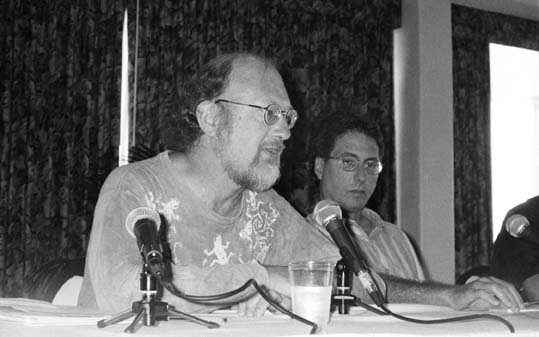 D. McKenna (pictured at right): Yes I do, I think that Andy makes the good point, that
psychedelics can be important in individuals' lives in terms of orienting
them to a wider vision or be an influence in terms of directing people. I
think psychedelics ultimately are something that you come to as an
individual. The challenge that we face is trying to relate our own
individual experience and its influence in our own lives to the greater
society, and ultimately beyond society to our species' fate. This is where
the challenge lies, trying to reconcile these two, because the way that at
least our western society is structured, there are no paradigms for
joining these two. In fact, societies seem mostly set up to discourage
this kind of self discovery and to repress it by legislative means if
necessary, but by whatever means. It is not something that is encouraged.
I think that one of the biggest challenges for the next millennium is, how
are we going to take our own individualistic psychedelic visions or
inspirations and try to diffuse those into a larger society. This is
always the problem. As Andy has said earlier, now that you have the
vision, what do you do with it and how do you somehow give expression to
it in the way you live and the way that society operates.I think that is
really the challenge. I am optimistic too, it must be that optimism is
infectious because I think there are a lot of discouraging things going on
but overall I think that trends are in the right direction.
D. McKenna (pictured at right): Yes I do, I think that Andy makes the good point, that
psychedelics can be important in individuals' lives in terms of orienting
them to a wider vision or be an influence in terms of directing people. I
think psychedelics ultimately are something that you come to as an
individual. The challenge that we face is trying to relate our own
individual experience and its influence in our own lives to the greater
society, and ultimately beyond society to our species' fate. This is where
the challenge lies, trying to reconcile these two, because the way that at
least our western society is structured, there are no paradigms for
joining these two. In fact, societies seem mostly set up to discourage
this kind of self discovery and to repress it by legislative means if
necessary, but by whatever means. It is not something that is encouraged.
I think that one of the biggest challenges for the next millennium is, how
are we going to take our own individualistic psychedelic visions or
inspirations and try to diffuse those into a larger society. This is
always the problem. As Andy has said earlier, now that you have the
vision, what do you do with it and how do you somehow give expression to
it in the way you live and the way that society operates.I think that is
really the challenge. I am optimistic too, it must be that optimism is
infectious because I think there are a lot of discouraging things going on
but overall I think that trends are in the right direction.
C. Grob: We have time for questions or comments for Andy.
L. Huxley: I would like to say one thing. Andy has given me, I think all
of us, a great hope that one of these visionary common sense ideas might
become true one of these days. I think that in a conscious society, a
great doctor would say to his patient, look here, I am going to try to do
my best for you but I can do very little. But I have one little bit of
news, you can do a lot for yourself. Maybe that is going to happen because
of you.
Audience question: Dr. Weil, here is another element of how psychedelics
might be helpful in our health; I know there are a lot of things going on
in my body I am not aware of, and perhaps some things which need
attention. Perhaps there is cholesterol building up, or perhaps I am
keeping muscle tension in certain places, or perhaps my insulin is off, so
I am not aware of these things. We have these marvelous plants that help
to increase our awareness, are there particular techniques or particular
plants that might help us become more aware of what is going on in our
bodies and where our attention may need to be focused?
A. Weil: Well first of all, I don't think you need to become aware of too
much of what is going on in your body. I think it is good to assume that
your unconscious mind is running things just fine. I think you could make
yourself very crazy by becoming too aware of what is going on. Think if
you had to consciously run all the things in your body, that would be a
nightmare. However, it is clear that in some people that come for medical
attention, the problem has been that they have ignored things that they
should have paid attention to. In most cases, that is not even visionary
common sense, it is just basic old common sense. Runners that run in spite
increasing pain in their knees, for example, are just ignoring simple
common sense. So I think in the general public there is a kind of basic
body awareness that people should know about. I am committed to bringing
that kind of information to kids because I think we don't do a very good
job about giving children preventive health information and I think the
principles are very simple and I am not so sure we need psychedelic tools
to do that. I think that is just basic common sense. I have a wonderful
collection of anecdotes of people who, using psychedelics, have become
aware of information from their body that was very useful to them.
Absolutely, I have seen that over and over, that has helped guide them in
choices that they have made in knowing that there was something wrong with
their body or something was not wrong with their body. So I think they
certainly can function that way and again I can see a potential use for
them.
D. McKenna: I would like to ask Andy, coming off your question, do you see
psychedelics as a potential diagnostic tool for physicians, being used
much in the same way that ayahuasca for instance, would be in tradition
settings?
A. Weil: That's a very interesting question. We have twelve core subjects
in the Integrative Medicine Program that the physicians are learning and
we have recruited faculty of the whole University of Arizona as well as
outside to develop these courses. One of the courses is called The Art of
Medicine and this is all material that is not usually taught in medical
schools; one aspect of this is intuition. I have always maintained that
all diagnosis was based on intuition and that all of the great
diagnosticians that I have met have been highly intuitive, although they
may not have recognized that themselves. I think that the diagnostic tests
that we do can be used to confirm or discard hunches that you form
intuitively. But a problem in our educational system is that not only is
intuition not rewarded, actually students are actively penalized for using
intuition and not relying on objective data. And that has gotten even
worse with the whole medical malpractice situation because now, with the
great fear of litigation, there is more and more emphasis on not doing
anything unless you have objective numerical data to support what you do.
So, I am very much interested in how you train intuition in people and I
could imagine a future world in which psychedelics were available for
that, they could be used in a way to become more aware. Everybody is
intuitive, but most of us aren't trained to pay attention to it or to act
on it and I think that is the challenge. I could definitely see drugs
being used in that way.
Audience question: Your talk made me think about three different kinds of
people or three different kinds of situations, I am not quite sure how to
say it but, there are people who have taken psychedelics early in their
lives or careers and kicked the visions into their lives, there are people
who are involved in spiritual practices in which the use of psychedelics
is an ongoing thing and there are people who take psychedelics over and
over again and don't seem to do very much into bringing it into their
lives. Have you thought about what accounts for the differences among
those three kinds of people?
A. Weil: I haven't. I will add, by the way, a fourth category, which is
people who have had the vision without ever using psychedelics. And they
can either take it into their lives or not, as well. No, I haven't thought
about that, I don't know. I don't know what accounts for that.
Audience question: My comment might be a good follow up to that. My
experience started with spontaneous visions as a teenager and then into
meditation and then occasional use of psychedelics and then a lot more
meditation, long retreats which seemed to duplicate the psychedelic
experience through natural meditative practices. And then, going into
medicine and psychiatry and now six years of psychoanalytic training. I
think the basic ego strength of the user before the psychedelic experience
or the spontaneous ego experience is a big factor in whether you bring
this vision into the world or not. We are getting into the realm of
psychiatry and a lot of these issues may have to be dealt with, with a
dialogue between internal medicine and psychiatry as well as alternative
medicine. In many ways psychiatry may be behind the boat, but it may be
the future of how we integrate. How do we bring forth the natural healing
abilities of the unconscious mind into our personal lives and bring out
those visions that are within us into manifestation in helping the world
with its problems?
A. Weil: That makes me think of several things; first is that the first
time that I took mescaline in my freshman year, I really had minimal
experience because I think I had so much anxiety about it. I took it again
about a month later and had what certainly felt to me like a mystical
experience and it was very overwhelming. But I think when I came out of
it, some part of me knew that if I followed through with the implications
of it I was not going to go through college and medical school. I kind of
shut that all off and it wasn't until I was probably out of medical
school, beginning to do an internship, that I began to experiment with
psychedelics again and recover that. I think if at that point I would have
pursued a psychedelic career I would have not gotten my medical degree and
not done what I now do. So that makes me somewhat cautious about young
people and that is one thing that I might tell young people; there may be
an appropriate time in life to do this and that maybe it is worth waiting
a certain period.
I CAN'T IMAGINE WHAT would have happened to me if I would have discovered
these drugs when I was in high school, for example. Another thought that I
have is to what you said about psychiatry and medicine; I think this is
one of the great tragedies of modern medicine and is really part of the
legacy of Descartes. There are people who say that if western civilization
took one wrong turn, it was with Descartes; certainly the split between
psychiatry and medicine is in that Cartesian tradition. I think it is very
unfortunate. I am doing what I can to repair that. I was asked to give
psychiatry grand rounds at the University of Arizona a few months ago and
to my delight, they were very unhappy that they had been left out of the
Integrative Medicine Program and wanted to know how they could
participate. So, I have definitely opened a dialogue with the psychiatry
department. Even if they just want to get in on a level of doing research,
that is fine. I would like to involve them much more. The concept behind
psychiatry--the word means soul doctoring--I can't imagine anything more
important, especially if you feel as I do, that much if not all of disease
originates on the nonphysical level and then eventually manifests on the
physical level. And yet, it is so ironic that of all of the medical
specialties, psychiatry is the one that is most mired in materialism and
sees all disorders of consciousness as being the result of brain
biochemistry, when it could just as well be the other way around. And that
all therapy is giving people drugs and if a psychiatrist is treating a
person who develops a physical problem they are referred to an internist
and if an internist has a patient who is believed to have an emotional
problem, they are referred to a psychiatrist and there is no conversation
there. That is a big problem, it is something very wrong with medicine
today, and something that we are trying to fix.
Audience question: I would like to follow up on that, being a
psychiatrist. I really like your thing about, "Anything is possible."
Another dichotomy that I see, that worries me, and that it is often
expressed in a psychedelic group, is the dichotomy between western
medicine and alternative medicine. I liked your concept of Integrative
Medicine rather than the idea that "If you take Prozac you are bad; if you
take St. John's Wort-- which is a herb but it is medication--you are
good."
A. Weil: I get concerned about that kind of dichotomy, so the whole thing
of, "Anything is possible and everything should be integrated," is another
area that I don't see very many people addressing. Let me expand that even
more. To generalize, the basic problem is the either/or model. And again,
this is something that I relate to a psychedelic experience. I remember an
even earlier acid experience in Death Valley. It was one night on a full
moon in June, so it was blazing hot in the day, but during the hours that
I was on LSD I couldn't tell whether I was warm or cold at night. I felt
both sensations simultaneously, and to me that experience of ambivalence,
of paradox is something that has been very much alive for me in
psychedelic experience. It has always led me to approach things from a
both/and formulation rather that either/or formulation. And I think that
whenever you run up against either/or formulations, you should try to
replace it with both/and.
Audience question: I first read The Natural Mind when I was in my first
year of medical school and that was my first exposure that there was
something called alternative medicine, which you discussed as a sort of
natural outcome of a psychedelic world view. I find that book to still be
perhaps the most cogent, conducive, intelligent discussion of drugs and
their role in society that I have ever read. At the time that you wrote
that you were fairly unknown and I don't think very many people have read
it. Now that you have found a large audience, I would like that book to
find a large audience and would like to see a revised version, written to
reach out to the public. At the same time, I see that might really
jeopardize what you are trying to do-- bringing alternative medicine into
the fold--so that is a paradox but I just wanted to put out that I would
like to see more people find that book without it somehow endangering your
status of bringing alternative medicine into the mainstream.
C. Grob: We can take one more question or statement before the break.
Audience question: I would like you to elaborate a little bit more on an
either/or, both/and issue that I face. I am a psychiatrist and I work with
oncology patients and the question is, on the one hand there are a lots of
alternatives and things that people can do to get better, but on the other
hand you speak very cogently about the dangers of guilt and responsibility
for getting better. The biological power of illness is so great that
sometimes patients come to me and they are overwhelmed with possibilities.
They shout, "What should I do? I am not meditating well enough, I am not
doing enough imagery, etc." How do I help them to get to a both/and model?
A. Weil: In Spontaneous Healing I have a chapter called Cancer as a
Special Case, and I really find it useful for a lot of reasons to separate
cancer out from other sorts of diseases. It is the one in which the
polarization between conventional and alternative medicine is most
intense. I think cancer is different in that, by the time we diagnose it,
it is a condition of very long standing, in which the body's healing
mechanisms have failed. So you are up against a different order of
magnitude of difficulty than in moving other kinds of diseases. There have
been so many New Age books about cancer, talking about the mind-body
connection. Frankly, I am very skeptical of a lot of that. My sense is
that cancer mostly results from very complex interactions between genes
and environment, in which the role of emotions and belief is obscure. I
can see how states of grief or depression could suppress immunity and
allow a preexisting cancerous tumor to grow faster, but I personally don't
think that mental factors have a great deal to do with the origin of
cancer. That is my own belief. I think in working with cancer patients, it
is very appropriate to tell them that their mental states have a role in
their general health and can specifically affect immunity, and to give
them techniques like visualization that can help with that, but I think
one has to be very careful about feeding into that idea, "You gave
yourself cancer." I told a story in Spontaneous Healing, that I will just
repeat that I think is very revealing.
I have always liked asking patients why they think they got sick, and I am
interested in how people formulate that to themselves. When I was a
medical student, this was in the late Sixties, I asked a lot of women who
had breast cancer--and these were women of my grandmother's
generation--why they thought they got breast cancer. Everyone, one hundred
percent, said that they got it because they had a past injury. The
typical formulation was, "Thirty years ago, I fell against the kitchen
table and hit my breast," or "I was in a car accident and my breast got
hurt." We know of no connection of trauma and breast cancer, but that was
how women in that generation explained breast cancer to themselves.
WHEN I ASK WOMEN TODAY with breast cancer why they got breast cancer,
nobody ever mentions injury. Now all I hear is formulations like, "For all
those years I bottled up my feelings," or "I never expressed the rage I
felt towards my husband." Now, I don't think we have any greater evidence
that breast cancer results from bottled up feelings than from past trauma,
but this represents an enormous social shift in this culture in how women
explain breast cancer. And there is a big difference here, because if you
think you got breast cancer because you fell against the kitchen table,
that is an act of God, it is an accident. If you think you got breast
cancer because you bottled up your feelings, it is your fault. It is
failure on your part. That has very different implications for how you
think about yourself. And personally, I am very uneasy about the amount of
popular literature that feeds into those formulations today, about cancer.
That is all I can tell you. I think it is a very careful line that you
have to walk, and I think the thing that you want to focus on is telling
people that their states of mind probably influence their immunity and
their level of general health, so it is worth trying to work on that
through whatever techniques we can offer them, but that there is no point
in looking for how that fed into the origin of the illness.
Next Article
|
